
BES PortalLogin / BES OS
BES Indoor Air Product Family
Air Hygiene

HAS

Hygienic Air System

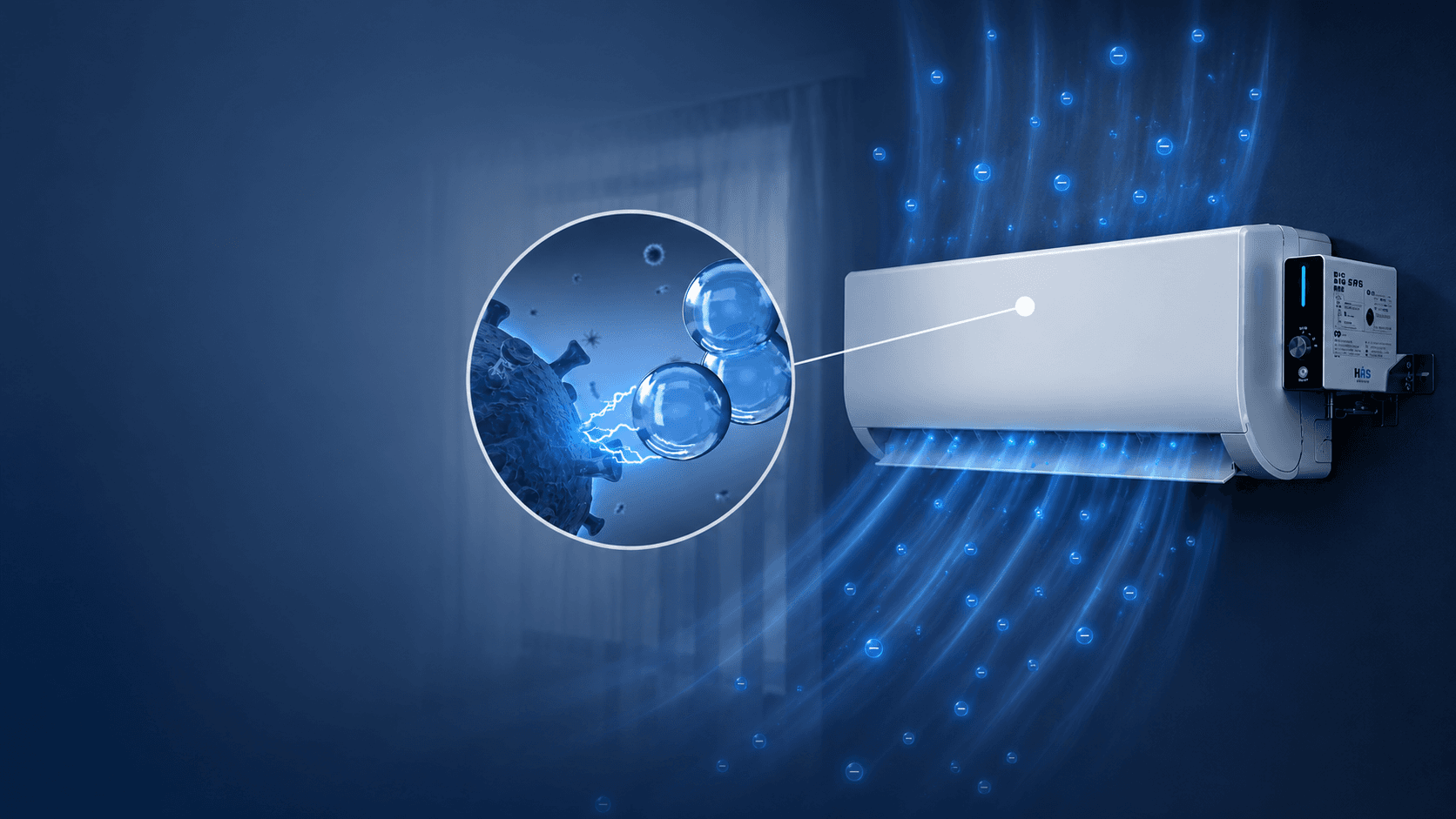
Hygienic Air System powered by Electrolytic Ozone Generator (EOG) technology. HAS generates aqueous ozone air from pure water for continuous sanitization, odor reduction and air-conditioning hygiene support without chemical residue or NOx.

  • Electrolytic Ozone Generator (EOG) technology
  • Generates aqueous ozone air from pure water
  • NOx-free ozone purity approximately 20 wt%
  • Designed for air-conditioning fan coil integration
CE Mark: Conformité Européenne
Technology
Electrolytic Ozone Generator (EOG)
Model
EOS7170-H
Output
Aqueous Ozone Air
Application
30–200 m²
KEY HIGHLIGHTS
Electrolytic Ozone Generator (EOG) technology
Generates aqueous ozone air from pure water
NOx-free ozone purity approximately 20 wt%
Designed for air-conditioning fan coil integration
Supports bacteria, virus, mold, allergen, odor and VOC control
Continuous operation with 24-hour initial usage recommendation
APPLICATIONS
Indoor air hygiene
Hospital and clinic air-conditioning units
Office and meeting rooms
Hotel guest rooms
Home and residential rooms
Odor and VOC control areas
PRODUCT SPECS
Model
EOS7170-H
Technology
Electrolytic Ozone Generator (EOG)
Output
Aqueous Ozone Air
Ozone Purity
≈20 wt% / NOx free
Application
30–200 m²
Operation Modes
Mode I 30 m² / II 50 m² / III 75 m² / IV 100 m²
Flow Pressure
0.5 Bar (0.05 MPa / 7.3 psi)
Adapter Input
AC 100–240V, 50/60Hz
Adapter Output
DC12V, 1.25A
Rated Power
<15 W
Water Requirement
RO DI / distilled water, TDS <3 ppm, conductivity <5 μS/cm
Water Storage Volume
580 ml
Water Consumption
Mode I 0.42 / II 0.56 / III 0.71 / IV 1.00 ml/hr
Working Temperature
1–40°C (33.8–104°F)
Working Humidity
0–90% non-condensing
Material
ABS casing / PVC, PVDF, PTFE tubing
Dimensions
W56 × D225 × H180 mm
Weight
0.8 kg net / 2.0 kg filled with water & bracket
Protection Class
IPX2
EOG Cell Life
≈9,000 operational hours / at least 12 months
HAS · ROOM-SCALE OCCUPIED-ZONE TREATMENTEngineering visualization showing airflow direction, suspended aerosol, reactive oxygen species, treatment density and recirculation.AEROSOL OUTLETHAS · ROOM-SCALE OCCUPIED-ZONE TREATMENTHUMIDIFIED OZONE AEROSOL + ROSENGINEERING DISPERSION LEGENDAIRFLOW DIRECTIONHUMIDIFIED OZONE AEROSOLREACTIVE OXYGEN SPECIES (ROS)HIGHMEDIUMLOWPRODUCT → HUMIDIFIED OZONE GENERATION → AEROSOL FORMATION → ROS DISTRIBUTION → OCCUPIED ZONE TREATMENT → CONTINUOUS AIR RECIRCULATION
INSTALLATION GUIDE

Typical installation examples

Practical reference layouts for applying HAS in real operating environments.

QUICK SIMULATION

HAS CT Air Treatment Simulator

One simulator for safety and treatment. Residual O₃ must stay below the 0.05 ppm planning maximum, while Effective CT is reduced by room coverage, leakage and contamination load before comparing with the CT standard.

Open Advanced Simulation →
Inputs
Engineering note
Safety C is checked against the occupied-space planning limit of 0.05 ppm.
Effective CT is the treatment KPI and is calculated after room coverage, leakage and contamination load are applied.
HAS uses the selected operation mode and runtime to estimate active treatment time.
INTERPRETATION
C being safe does not automatically mean the treatment is enough. CT must also pass, and if the room is larger than the rated area, CT is reduced by the coverage factor.
Safety C
0.007 ppm
Std ≤ 0.05 ppm
Effective CT
8.3
Std ≥ 0.5 ppm·min
Coverage
100%
Area OK
Status
PASS
CT PASS
Water / cell usage
Water use
10.1 ml
Cell usage
0.27%
CT ACCUMULATION GRAPH

Effective CT vs Standard

8.3 ppm·min / Std 0.5
Effective CT ppm·minSTD 0.5 ppm·min0 hr24 hr
LIVE CALCULATION

How CT is calculated

1) Room volume = Room area × Ceiling height = 30.00 m² × 2.50 m = 75.0
2) Theoretical O₃ input = Ozone output ÷ Room volume ÷ 2.14 = 7.50 mg/h ÷ 75.0 m³ ÷ 2.14 = 0.040 ppm/h
3) Residual safety C = Theoretical O₃ × buildup / engineering loss = 0.007 ppm (0.015 mg/m³) → Std ≤ 0.05 ppm = SAFE
4) Effective C for CT = Residual C × Coverage × Leakage ÷ Load = 0.007 × 1.00 × 0.85 ÷ 1.00 = 0.006 ppm
5) Active runtime = Runtime × Duty = 24.0 hr × 100% = 24.0 hr
6) Effective CT = Effective C × Active runtime × 60 = 0.006 × 24.0 × 60 = 8.3 ppm·min
7) CT standard = 0.5 ppm·min → PASS
Note: HAS mini values are engineering estimates based on product output and room inputs. Final site validation should use an ozone sensor and site SOP.
Verified Certification Profile

Certifications

Certification claims are read from the shared BES certification registry. Available controlled documents are linked from the product resource center.

Open BES Certification Center
RELATED SOLUTIONS

Connect this product to applications

Indoor AirHospital
Humidified Ozone HandbookEngineering Application Library
FAQ

HAS product questions

Where is system sizing completed?

Room conditions, coverage, quantity and operating strategy are evaluated in the Indoor Air Engineering application. This page documents the product itself.

Which water and installation requirements apply?

Use the water quality, clearance, power and mounting requirements stated in the current product manual. Site conditions should be reviewed before installation.

Is HAS a portable room sanitizer?

HAS is documented as an HVAC/fan-coil integrated platform. Use the Indoor Air Engineering application to confirm the appropriate architecture for the site.

Compare ProductsSelect up to 3 BES products