
Maintain pipework and outlets
Support control of slime and microbial buildup along the wetted distribution path.

Before reaching the glass, water still passes through pipework, valves, fittings and dispensing outlets. Water can remain in these areas and allow slime to build up, so distribution hygiene must be maintained alongside filtration.
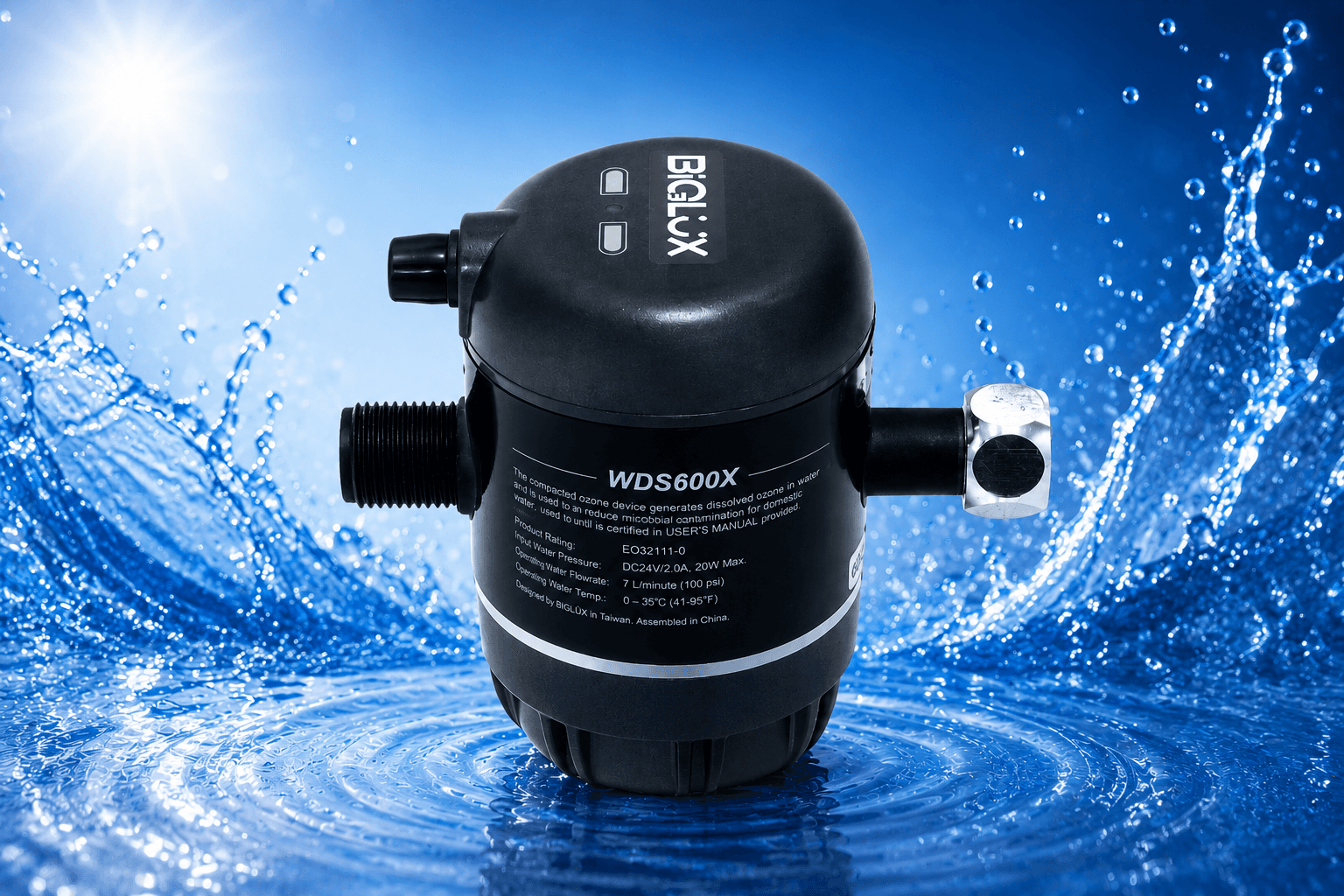
CIP maintains cleanliness inside pipework, valves, fittings and dispensing outlets by separating the cleaning cycle from drinking-water delivery. BES reviews the existing filtration system and points of use, then designs an ozonated-water mode to suit the installation. WDS600X is used as the equipment example provided for this concept.
Support control of slime and microbial buildup along the wetted distribution path.
Supply ozonated water through a glass-rinse outlet when the user activates it.
Add downstream distribution care without presenting ozone as a replacement for filtration.
Valve locations, water paths, concentration and operating time must be set for the actual system. Example timings are not default recommendations for every site.
Select a mode to see the valve states and active water path across the same system architecture, and adjust the inputs to view the theoretical concentration in the ozonated-water path. This is not an installation drawing.
Choose a mode to see how it works
Adjust ozone production and water flow to view a basic mass-balance result. This value applies only to the ozonated-water path in CIP and Rinse modes.
Ozone production ÷ water flow: 60 mg/h ÷ 150 L/h
This value applies to the CIP/Rinse path; drinking-water delivery does not pass through the ozone unit.
At the same ozone output, a higher water flow rate produces a lower theoretical concentration.
The value at the point of use may differ from the theoretical result because it depends on transfer, decay, water quality and the distribution path.
The calculation assumes all generated ozone is mixed uniformly into the flowing water, without deducting transfer losses, decay or ozone demand. It is not a guaranteed value or a microbial-reduction result.This illustration shows how the water paths are separated within one system architecture. Final valve locations, pipework and operating details must be defined for the actual installation.